









reduction in risk disease
progression or death1
In TB-01 study
6.9
months
mPFS
with DATROWAY
(95% CI: 5.7–7.4)
VS
4.9
months
mPFS
with chemotherapy
(95% CI: 4.2–5.5)
(HR=0.63; 95% CI: 0.52, 0.76; P<0.0001)
PFS (BICR) and OS were dual primary endpoints.1
The study was positive if either PFS or OS results were statistically significant.2.
Median OS (dual primary endpoint): 18.0 months with DATROWAY and 18.3 months with chemotherapy. (HR=1.01; 95% CI: 0.83, 1.22). Data was not statistically significant1
For adults with previously treated HR+/HER2- mBC
DATROWAY delivered superior mPFS vs chemotherapy with a favorable benefit-risk profile1
PFS (BICR) and OS were dual primary endpoints.1
The study was positive if either PFS or OS results were statistically significant.16
TRAEs refer to adverse events possibly related to treatment as assessed by the investigator. Adverse reactions refer to adverse events which have a likely basis for a causal relationship between the drug and the occurrence of the adverse event.10
aInvestigator’s choice of chemotherapy included eribulin, capecitabine, vinorelbine, or gemcitabine.1
*Pooled safety profile has been assessed from two clinical studies involving 443 patients who received Datroway 6 mg/kg body weight for the treatment of breast cancer1
Consideration for
DATROWAY patient eligibility1
(HER2-negative)
IHC 0, IHC 1+, or IHC 2+/ISH-
Progressed on ETa
Received prior chemotherapya
(+/- other systematic therapy)
- Common
adv. Events - Select
safety data - Adverse Events
Management - Specific
Populations
Common adverse Events
The majority of common adverse reactions were Grade 1 or 2 with DATROWAY
Treatment-related adverse events (TRAEs) (all grades) Occurring in ≥10% of Patients and Grade ≥3 TRAEs in ≥1% of Patients in Either Arm (safety population)10
Swipe to view full table
Median duration of treatment was longer in the
Dato-DXd arm compared with the ICC arm
(6.7 months [range, 0.7-15.6] 4.1 months
[range, 0.2-17.4]).10
Includes adverse events assessed by the
investigator as possibly related to study treatment.
aGrouped term comprising keratitis, punctate keratitis, and ulcerative keratitis.
bGrouped term comprising neutropenia and neutrophil count decreased.
cGrouped term comprising leukopenia and white
blood cell count decreased.
dThe most common Grade ≥3 TRAEs with
chemotherapy were neutropenia (31%), leukopenia
(7%), and stomatitis (3%).10
Grade ≥3 TRAEs3
with DATROWAY
with chemotherapyd
Grade ≥3 neutropenia was 1% with DATROWAY and 31% with chemotherapy. 3% of patients on DATROWAY and 22% of patients on chemotherapy required G-CSF treatment.10 Patients that had TRAEs associated with death: 0 with DATROWAY vs. 1 with chemotherapy3
Select safety data, special warnings and precautions for use1
Contraindications
Hypersensitivity to the active substance or to any of the excipients.
Warnings and Precautions
Interstitial lung disease/pneumonitis
Cases of interstitial lung disease (ILD), including pneumonitis, have been reported in patients treated with Datroway. Fatal outcomes have been observed.
ILD/pneumonitis occurred in 4.7% of the pool of patients with breast cancer treated with Datroway
6 mg/kg, of which 3.6% were adjudicated as drug-related ILD/pneumonitis by independent review.
Most ILD/pneumonitis cases were Grade 1 (2.9%). Grade 2 events occurred in 0.9% of patients.
Grade 3 events occurred in 0.9% of patients. Adjudicated drug-related Grade 5 events occurred in 0.2% of patients. Median time to first onset was 5.8 months (range: 1.1 to 10.8).
Ocular adverse events
Datroway can cause ocular surface undesirable effects including keratitis. Signs and symptoms
of keratitis may include dry eye, increased lacrimation, photophobia, and detrimental changes to vision.
Ocular surface undesirable effects occurred in 49.0% of the pool of patients treated with Datroway, of which 35.0% were Grade 1, 12.2% were Grade 2 and 1.8% were Grade 3. Keratitis occurred in 17.8% of the pool of patients treated with Datroway, of which 13.3% were Grade 1, 3.6% were Grade 2 and 0.9% were Grade 3. The median time to onset was 4.1 months (range: 0 to 23.2). Discontinuation due to keratitis occurred in 0.5% of patients.
Stomatitis
Stomatitis, including mouth ulcers and oral mucositis, have been reported in patients being treated with Datroway.
Stomatitis occurred in 64.8% of the pool of patients treated with Datroway, of which 29.3% were Grade 1, 27.5% were Grade 2 and 7.9% were Grade 3. Median time to first onset was 0.6 months
(range: 0.03 to 12.2). Discontinuation due to stomatitis occurred in 0.5% of patients.
Traceability
In order to improve the traceability of biological medicinal products, the name and the batch number of the administered product should be clearly recorded.
Patients with moderate or severe hepatic impairment
There are limited data in patients with moderate hepatic impairment and severe hepatic impairment. As metabolism and biliary excretion are the primary routes of elimination of the topoisomerase I inhibitor, DXd, Datroway should be administered with caution in patients with moderate and severe hepatic impairment.
Embryo-foetal toxicity
Based on findings in animals and its mechanism of action, the topoisomerase I inhibitor component of Datroway can cause embryo-foetal harm when administered to a pregnant woman.
Excipient with known effect
This medicine contains 1.5 mg of polysorbate 80 in each vial. Polysorbates may cause allergic reactions.
Prophylactic and supportive regimens for selected adverse events1,9,10,11
Premedication, concomitant medications, and required eye care
Stomatitis
- When starting DATROWAY, and throughout treatment, advise patients to use dexamethasone oral solution 0.1 mg/mL (or similar steroid-containing mouthwash) for prophylaxis 4 times daily and as neededb
- Instruct the patient to hold ice chips or ice water in the mouth throughout the infusion

Dexamethasone oral solution
(or similar steroid-containing mouthwash)
For discussion with patients9,11
- Suggest patients to swish for 1-2 minutes with oral solution and then spit out
- Encourage patients to brush with a soft toothbrush and continue flossing, if it’s already part of their routine
Prophylaxis was recommended but not mandated in the trial because it was not globally available.10
Ocular adverse events
- Advise patients to use preservative-free lubricant eye drops several times daily for prophylaxis
- Advise patients to avoid use of contact lenses unless directed by an eye care professional
- Refer patients for appropriate ophthalmologic assessments for any new or worsening ocular signs and symptoms that could suggest keratitis
- Keratitis should be monitored and if diagnosis is confirmed, Datroway should be dose delayed, dose reduced, or permanently discontinued
- Carefully monitor patients with pre-existing keratitis

Lubricant eye drops and avoid contact lenses
Nausea and vomiting
- It is recommended that patients receive prophylactic antiemetic agents (dexamethasone with 5-HT3 antagonists as well as other medicinal products, such as NK1 receptor antagonists) prior to infusion of Datroway and on subsequent days as needed.

Antiemetic medications
Infusion-related reactions
- Administer premedication, including antihistamines and antipyretics, 30-60 minutes prior to each infusion
- Example: Diphenhydramine 25-50 mg and acetaminophen 650-1000 mg intravenously or orally
Antihistamines and antipyretics
Interstitial Lung Disease (ILD) management1
Interstitial lung disease (ILD)
Patients should be advised to immediately report cough, dyspnoea, fever, and/or any new or worsening respiratory symptoms. Patients should be monitored for signs and symptoms of ILD/ pneumonitis. Evidence of ILD/pneumonitis should be promptly investigated.
Patients with suspected ILD/pneumonitis should be evaluated by radiographic imaging. Consultation with a pulmonologist should be considered. For asymptomatic (Grade 1) ILD/ pneumonitis, consider corticosteroid treatment (e.g. ≥ 0.5 mg/kg/day prednisolone or equivalent).
Datroway should be delayed until recovery to Grade 0 and may be resumed. For symptomatic ILD/pneumonitis (Grade 2 or greater), promptly initiate systemic corticosteroid treatment (e.g. ≥ 1 mg/kg/day prednisolone or equivalent) and continue for at least 14 days followed by gradual taper for at least 4 weeks.
Datroway should be permanently discontinued in patients who are diagnosed with symptomatic (Grade 2 or greater) ILD/pneumonitis. Patients with a history of ILD/pneumonitis may be at increased risk of developing ILD/pneumonitis and should be monitored carefully.1
Monitor

Look for signs and symptoms that may indicate ILD/pneumonitis1:
- Cough
- Dyspnea
- Fever
- New or worsening respiratory symptoms.

Promptly investigate evidence of ILD/pneumonitis9:
- Diagnosis of ILD/pneumonitis requires the exclusion of other causes
- Evaluation should include:
- High-resolution CT
- Pulmonologist consultation
- Blood culture and CBC
- Bronchoscopy and BALa
- Pulmonary function tests and pulse oximetry
- Blood sample for arterial blood gasesa and PK analysisb
- All events of ILD/pneumonitis, regardless of severity, should befollowed until resolution, including after DATROWAY discontinuation
Reminder
Emphasize the significance of ILD/pneumonitis symptom monitoring and reporting with patients. This allows for prompt corticosteroid treatment. All events of ILD/pneumonitis, regardless of severity, should be followed until resolution, including after DATROWAY discontinuation1,9
Grading scale (NCI CTCAE v5.0) and dose modifications
(Interrupt DATROWAY for any ILD/pneumonitis event regardless of grade. )
GRADE 1
GRADE 2
GRADE 3
GRADE 4
GRADE 5

DELAY
Withhold DATROWAY until ILD/pneumonitis is completely resolved, then:
- If resolved in ≤28 days, maintain dose
- If resolved in >28 days reduce one dose level Consider corticosteroids (eg, ≥0.5 mg/kg/day prednisolone or equivalent) as soon as ILD/ pneumonitis is suspected.

DISCONTINUE
Permanently discontinue DATROWAY.
Promptly initiate corticosteroid treatment as soon as ILD/pneumonitis is suspected.
BAL=bronchoalveolar lavage; CT=computed tomography; CBC=complete blood count; PK=pharmacokinetic.
aIf clinically indicated and feasible.9
bObtain blood sample as soon as ILD/pneumonitis is suspected, if feasible.9
Each patient is unique; when treating with DATROWAY, consider institutional guidelines.
Remind your patients about the important role prophylactic measures may play in preventing adverse events9
5-HT3=5-hydroxytryptamine type 12.
Use in Specific Populations
Women of childbearing potential/Contraception in females and males:
- The pregnancy status of women of childbearing potential should be verified prior to initiation of Datroway.
- Women of childbearing potential should use effective contraception during treatment with Datroway and for at least 7 months following the last dose. Men with female partners of childbearing potential should use effective contraception during treatment with Datroway and for at least 4 months following the last dose.
Pregnancy:
- There are no available data on the use of Datroway in pregnant women. However, based on findings in animals and its mechanism of action, the topoisomerase I inhibitor component, DXd, can be expected to cause embryo-foetal harm when administered to pregnant women.
- Datroway is not recommended during pregnancy and in women of childbearing potential not using contraception. Patients should be informed of the potential risks to the foetus before they become pregnant and to contact their doctor immediately if they become pregnant.
Breast-feeding:
- It is not known if datopotamab deruxtecan is excreted in human milk. Human IgG is excreted in human milk. Because of the potential for serious adverse events in breast-fed children, women should discontinue breast-feeding prior to initiating treatment with Datroway. Women may begin breast-feeding 1 month after concluding treatment.
Fertility:
- No human data on the effect of datopotamab deruxtecan on fertility are available. Based on results from animal toxicity studies, Datroway may impair male and female reproductive function and fertility.
- Both men and women should seek advice on fertility preservation before treatment. It is not known whether datopotamab deruxtecan or its metabolites are found in seminal fluid. Male patients must not freeze or donate sperm throughout the treatment period, and for at least 4 months after the final dose of Datroway. Females must not donate, or retrieve for their own use, ova throughout the treatment period and for at least 7 months after the final dose of Datroway.
Paediatric population:
- The safety and efficacy in children and adolescents below 18 years of age have not been established. No data are available.
Elderly:
- Of the 443 patients with breast cancer treated with Datroway 6 mg/kg, 23.3% were 65 years or older and 4.7% were 75 years or older. Data are limited to establish the safety in patients 85 years or older.
- There was a numerically lower proportion of Grade 3/4 adverse events (24.3% vs 25.0%) and a numerically higher proportion of serious adverse events (9.7% vs 6.8%) and adverse events leading to discontinuation (3.9% vs 3.5%) observed in patients aged 65 years or older compared to patients younger than 65 years old.
Renal impairment:
- No dose adjustment is required in patients with mild to moderate (creatinine clearance [CLcr] ≥ 30 and < 90 mL/min) renal impairment. The recommended dosage of Datroway has not been established in patients with severe renal impairment. Patients with severe renal impairment should be monitored carefully. In patients with moderate renal impairment at baseline who received datopotamab deruxtecan 6 mg/kg, a higher incidence of serious adverse events was observed compared to those with normal renal function. No dedicated renal impairment study was conducted. Based on population pharmacokinetic analysis including patients with mild to moderate (CLcr ≥ 30 and <90 mL/min) renal impairment (estimated by Cockcroft-Gault), the pharmacokinetics of datopotamab deruxtecan or DXd was not affected by mild to moderate renal impairment as compared to normal renal function (CLcr ≥ 90 mL/min).
Hepatic impairment:
- No dose adjustment is required in patients with mild (total bilirubin ≤ upper limit of normal (ULN) and any aspartate aminotransferase (AST) > ULN or total bilirubin > 1 to 1.5 times ULN and any AST) hepatic impairment. There are limited data to make a recommendation on dose adjustment in patients with moderate (total bilirubin > 1.5 to 3 times ULN and any AST) hepatic impairment. Insufficient data are available in patients with severe (total bilirubin > 3 times ULN and any AST) hepatic impairment. Therefore, patients with moderate and severe hepatic impairment should be monitored carefully.
- Q3W dosing
- Adverse reactions and dosage reduction
DATROWAY is the first TROP-2-directed ADC with one infusion in a Q3W interval1,12,14,17
The recommended dose of DATROWAY is 6 mg/kg a until disease progression or unacceptable toxicity 1
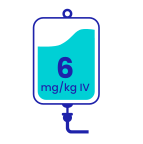

21-DAY CYCLE
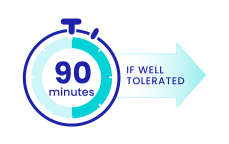
FIRST INFUSION

SUBSEQUENT INFUSIONS
Missed or delayed infusion?1
- If a planned dose is missed or delayed, administer as soon as possible, without waiting for the next cycle
- The schedule of administration should be adjusted to maintain a 3-week interval between doses.
Dosage forms and strengths1
Strength: 100 mg per vial
Pharmaceutical form: Powder for concentrate for solution for infusion. White to yellowish white lyophilised powder, which has a cake-like appearance.
The first infusion is to be administered over 90 minutes. Patients should be observed during the infusion and for at least 30 minutes following the initial dose for signs or symptoms of infusion-related reactions.
Subsequent infusions are to be administered over 30 minutes if prior infusions were tolerated. Patients should be observed during the infusion and for at least 30 minutes after infusion.
Premedication is recommended to help reduce the risk and severity of infusion-related reactions, nausea, and vomiting
Datroway should be prescribed by a physician and administered under the supervision of a healthcare professional experienced in the use of anticancer medicinal products.
aUp to a maximum of 540 mg for patients ≥90 kg.1
Adverse reactions should be managed with dose delays, reductions, or discontinuations, if needed1
Dose reductions for adverse events
Datroway dose should not be re-escalated after a dose reduction is made.
Swipe to view full table
*Per National Cancer Institute Common Terminology Criteria for Adverse Events (NCI CTCAE) version 5.0.6
#Grade 0 refers to full resolution of ILD/pneumonitis, including the disappearance of radiological findings associated with active ILD/pneumonitis.
Residual scarring or fibrosis following recovery of ILD/pneumonitis is not considered to be active disease.
Abbreviations
2L+, second line or later
5-HT3, 5-hydroxytryptamine type 3
ADC, antibody-drug conjugate
ALT, alanine aminotransferase
ARs, adverse reactions
AST, aspartate aminotransferase
BICR, blinded independent central review
CDK, cyclin-dependant kinases
CI, confidence interval
CR, complete response
Dato-DXd, datopotamab deruxtecan
DCR, disease control rate
DNA, deoxyribonucleic acid
DoR, duration of response
ECOG PS, Eastern Cooperative Oncology Group Performance Status
ET, endocrine therapy
G-CSF, granulocyte-colony stimulating factor
HER2-, human epidermal growth factor receptor 2-negative
HR+, hormone receptor-positive
HR, hazard ratio
ICC, investigator’s choice of chemotherapy
IHC, immunohistochemistry
ISH, in situ hybridization
IV, intravenous
mAb, monoclonal antibody
mBC, metastic breast cancer
mPFS, median progression-free survival
ORR, objective response rate
OS, overall survival
PFS, progression-free survival
PR, partial response
Q3W, once every 3 weeks
RECIST, Response Evaluation Criteria in Solid Tumors
SD, stable disease
TRAEs, treatment-related adverse events
TROP-2, trophoblast cell-surface antigen 2